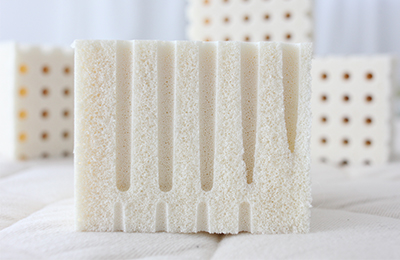
We have spoken about latex with many people representing many companies. We know how confusing it can be to sort out how it’s processed (Dunlop vs. Talalay), what’s added, how it’s shipped, how it’s tested, and what all the numbers mean.
Common Questions
What if I want 100% pure, natural latex?
What if I want 100% pure, natural latex?
You are going to find at most 95-97% natural latex in any latex mattress or topper. If someone tells you their finished product is “100% natural” latex, they are misinformed. That material does not exist. No manufacturer can simply whip rubber serum with air to produce natural foam rubber; the process does require tiny amounts of some additives.
What about the 5% that’s not rubber?
What about the 5% that’s not rubber?
It is mostly sulfur. We order and specify the purest natural foam rubber available anywhere. We also have our latex independently tested. We feel that what matters most is the purity and quality of the end product. That’s why we post our certifications on our site. In our judgment, the better sleep made possible by natural latex’s remarkable pressure-relieving and supportive qualities far offsets any hypothetical effect from tiny amounts of non-rubber material. There is simply no comparison in purity to synthetic or blended foams that include only small percentages of natural rubber.
How durable is a latex mattress?
How durable is a latex mattress?
Whether it’s Dunlop or Talalay, your natural latex mattress is going to last a long time. Many latex mattresses made in the 1950s lasted 30 years and longer. How long your mattress lasts will depend not only on how it’s made, of course, but also how it’s used.
For more detail, please see our variations in natural latex page.
The Basics
- Warm Climate. Rubber trees grow only within about 10 degrees of the equator.
- Collecting the serum. The trees are sliced at an angle, and a small amount of the serum is collected daily.
- Technique. The trees can be sliced about 180 days per year, except during the rainy season and the summer. The cut is about three feet long, and the serum flows for about an hour. Then the cut heals and the serum stops flowing.
- Location. Latex was originally cultivated in Brazil, but today the only rubber trees in Brazil are wild. Almost all latex used in manufacturing today comes from the Far East.
- Water. When the serum is harvested, it is about 2/3 water.
- Consistency. Latex serum in its pure state is fairly thick and needs to be processed. (It’s different from maple syrup making, in which very thin sap is boiled down to make thicker syrup.)
- Ammonia. All but one latex company we have asked have reported that a small amount of ammonia is added to the serum so it will not coagulate before processing. (One company said that their factory is next to the farm so they process it right there. However, we err on the side of caution and assume that everyone adds ammonia at first.) Ammonia is a naturally-occurring product that is washed out later in the processing.
- Froth. Next, the liquid latex needs to be expanded and concentrated. This is done by adding ingredients and whipping or frothing the material in a centrifuge.
- Washing latex. After vulcanizing, the natural latex is washed multiple times in clean running water and passed through heavy metal rollers that squeeze the water out.
- Allergies. Latex contains natural proteins to which some people are allergic. Severe latex allergy occurs in less than 1% of the U.S. population. Health care workers who wear latex gloves for long periods of time have a higher long-term risk of sensitization (10% to 15%). We offer samples so anyone who needs to check for reactions can do so, and explain latex allergy in depth on our blog.